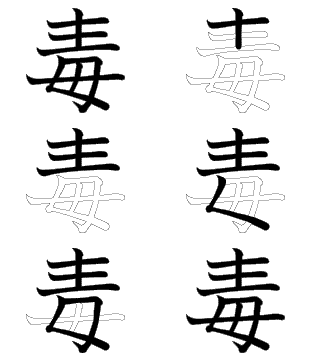
Kanji Card – 毒

Kanji – JLPT N3 – 毒

6BD2 – 毒

Meaning Poison
Onyomi
Kunyomi DOKU
Strokes 8 (click on the pick to start the video)

Vocabulary including the kanji 毒

Kanji Furigana Romaji Meaning JLPT
毒舌 どくぜつ dokuzetsu Wicked tongue

Kanji Radicals inside 毒

Radical Radical name Meaning
 –
 –
 –

JAPANESE EXAMPLE SENTENCES USING THe KANJI 毒

Kanji タバコは体に毒だ。
Furigana たばこはからだにどくだ。
Romaji Tabako ha karada ni doku da.
English Tobacco is a poison for the body.

SIMILAR KANJI to 毒


Subscribe & stay updated

If you enjoyed reading this then please consider subscribing by email and receive instant, daily or weekly updates.

Just click the SIGN ME UP! button on the right top of the page and start receiving  Japanese language updates.
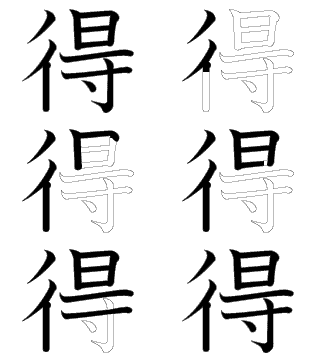

Kanji Card – 得

Kanji – JLPT N3 – 得

5F97 – 得

Meaning gain, profit, advantage
Onyomi TOKU
Kunyomi E
Strokes 11 (click on the pick to start the video)

Vocabulary including the kanji 得

Kanji Furigana Romaji Meaning JLPT
得意 とくい tokui Client, pride, one’s strong point
 得策  とくさく  tokusaku  The best, the best way
 得失  とくしつ tokushitsu  The pros and cons

Kanji Radicals inside 得

Radical Radical name Meaning
 –
 –
 –

JAPANESE EXAMPLE SENTENCES USING THe KANJI 得

Kanji それは何の得にもならない。
Furigana それはなにのとくにもならない。
Romaji sore ha nani no toku ni mo naranai.
English There is nothing to gain from this.

SIMILAR KANJI to 得


Subscribe & stay updated

If you enjoyed reading this then please consider subscribing by email and receive instant, daily or weekly updates.

Just click the SIGN ME UP! button on the right top of the page and start receiving  Japanese language updates.


A newbie’s journey through Japanese #4: Understanding kanji

Minasan, konnichiwa! Mike desu. It’s been a while since my last post, and that is because life has gotten incredibly busy. My wife and I are expecting our first child in August, so as you might imagine, my Japanese studies have taken a backseat to trying to get everything ready for our new arrival. It’s an exciting time, but also one where free time is in very short supply.

So I’m going to steal away some time during my lunch break to write this post. It concerns an issue that every beginning Japanese student has to face at some point if he or she wants to move beyond the most basic understanding of the language. Yes, I’m talking about those incredibly complex, multifaceted and often infuriating Chinese characters called kanji.

The very first question one might have when confronting kanji is: Why? The Japanese already have two writing systems, hiragana and katakana, for any syllable that can be uttered in the language. Aren’t those enough to go around?

Well, you could technically write any Japanese sentence in nothing but kana. But, believe it or not, that can actually be more tiring (and more confusing) to read. That is because each kana only represents one syllable, whereas kanji can contain multiple syllables in them. For example, take the very simple word for teacher, “sensei.” If you were writing this in kana, it would take four kana in sequence: se, n, se, i. Meanwhile, it only takes two kanji (sen, sei). So already, you’ve doubled your reading speed.

Another advantage is immediately understanding the meaning from the characters. Kana mean nothing on their own; they’re just sounds. Meanwhile, kanji have their meanings built right in. This helps avoid mistakes with words that sound the same, such as “hana.” The word looks the same written in kana, but in kanji can mean either nose or flower depending on the character.

Kanji is starting to sound like an incredibly useful system, isn’t it? There are a few caveats, though:

First, just because you are reading faster does not necessarily mean you are writing faster. That is one of the quirks of Japanese. Using my earlier example, “sensei” in kana takes nine strokes to write. But in kanji, though it is only two characters, it takes 11 strokes. And that is a minor example. For instance, take the Japanese word for love, “ai.” In kana, it’s five strokes. In kanji, that lone character of “ai” takes 13 strokes.

The other big hurdle of kanji is that the characters often have multiple sounds associated with them. Specifically, kanji can have both on readings (which are based on the Chinese pronunciation of the character when that character was first absorbed into the Japanese language; it is not necessarily the same sound in modern Chinese) and kun readings (the native Japanese pronunciation).

What’s more, kanji can have multiple on and kun readings depending on context and whether or not the character is used in a name. There are a few rules of thumb to figure out the correct pronunciation to use. Often, when you see three or more kanji jammed together, the characters are going to take an on reading, and when you see the character by itself or with kana trailing off the end of it, it’s going to take a kun reading. But guess what? Those are not hard and fast rules. In fact, there are so many exceptions to them and irregular pronunciations that before long you will probably throw those rules out the window and most likely feel overwhelmed and lost.

However, there is hope. And that is this: Practice, practice, practice. Find ways to use kanji in daily life and write them out whenever you can (this is something I will get more into in a future post). The language probably seems completely arbitrary in its rules, but in that way, it is like pretty much any language.

For example, consider this: Comb, tomb, bomb. Or this:  Predict, indict.  There is nothing in the words themselves that tell you the pronunciations are drastically different. Non-native English speakers would see those words, their similar spellings, and probably think they all have similar sounds. But you know how different they are. How? From being exposed to them, practicing them, hearing them and using them. It’s the same with kanji. My feeling is, if you can master a language as arbitrary as English, you can do it again with Japanese.

As always, I am interested in what you have to say and your experiences as well. Are there any podcasts you recommend for learning about Japan and the Japanese language? Let me know.


Did you like this post? Click here to read more from our Guest Writer Mike.

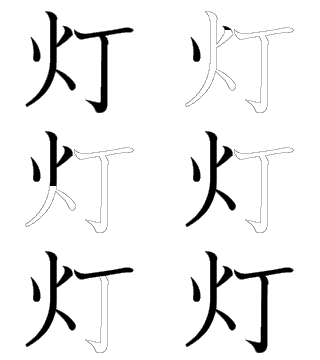
Kanji Card – 灯

Kanji – JLPT N3 – 灯

灯

706F - 灯

Meaning light, lamp
Onyomi TOU
Kunyomi hi
Strokes 6 (click on the pick to start the video)

Vocabulary including the kanji 灯

Kanji Furigana Romaji Meaning JLPT
灯台 とうだい toudai lighthouse

Kanji Radicals inside 灯

Radical Radical name Meaning
 –
 –
 –

JAPANESE EXAMPLE SENTENCES USING THe KANJI 灯

Kanji 遠い灯台のかすかな光を見た。
Furigana とおいとうだいのかすかなひかりをみた。
Romaji tooi toudai no kasukana hikari o mita.
English I saw the gleam of a distant lighthouse.

SIMILAR KANJI to 灯


Subscribe & stay updated

If you enjoyed reading this then please consider subscribing by email and receive instant, daily or weekly updates.

Just click the SIGN ME UP! button on the right top of the page and start receiving  Japanese language updates.

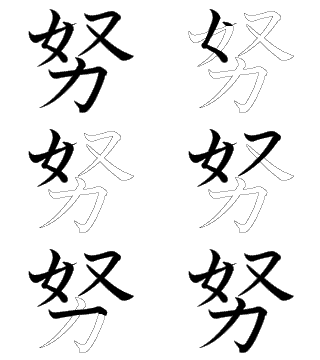
Kanji Card – 努

Kanji – JLPT N3 – 努

努

52AA - 努

Meaning to labour
Onyomi DO
Kunyomi tsuto(meru)
Strokes 7 (click on the pick to start the video)

Vocabulary including the kanji 努

Kanji Furigana Romaji Meaning JLPT
 努力 どりょく doryoku effort, endeavor

Kanji Radicals inside 努

Radical Radical name Meaning
 –
 –
 –

JAPANESE EXAMPLE SENTENCES USING THe KANJI 努

Kanji 私しは毎日努力して日本語ができるようになりました。
Furigana わたしはまいにちどりょくしてにほんごができるようになりました。
Romaji watashi wa mainichi doryoku shite nihongo ga dekiruyouni narimashita.
English I made efforts every day and become proficient in Japanese.

SIMILAR KANJI to 努


Subscribe & stay updated

If you enjoyed reading this then please consider subscribing by email and receive instant, daily or weekly updates.

Just click the SIGN ME UP! button on the right top of the page and start receiving  Japanese language updates.