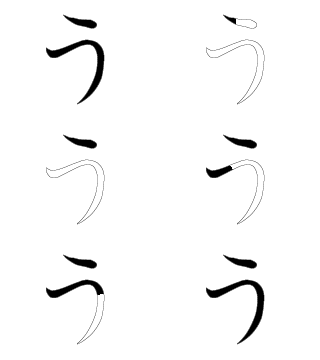
Hiragana Card – う

Hiragana U

う

3046 - u

Reading: u

Strokes: 2

Variations: none


HIRAGANA & KATAKANA TEST

Just follow this Twitter account and start receiving 10 tweets per day with randomly selected hiragana and katakana including links to the solution.


PRACTICE WRITING THE HIRAGANA う – U

Download the NIHONGO ICHIBAN PRINT YOURSELF Hiragana & Katakana Workbook and practice writing hiragana on worksheets that you can print at home as often as you like.

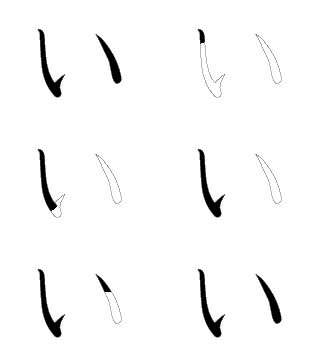
Hiragana Card – い

Hiragana I

い

3044 - i

Reading: i

Strokes: 2

Variations: none

The origin of this Hiragana


HIRAGANA & KATAKANA TEST

Just follow this Twitter account and start receiving 10 tweets per day with randomly selected hiragana and katakana including links to the solution.


PRACTICE WRITING THE HIRAGANA い – I

Download the NIHONGO ICHIBAN PRINT YOURSELF Hiragana & Katakana Workbook and practice writing hiragana on worksheets that you can print at home as often as you like.
Particle も (mo)

This particle is used to express “too” or “as well”. It always is related to the precedent noun. In case that the noun is followed by the particles が (ga) or は (ha) these are replaced by も (mo). In case that the precedent noun is followed by the particles に (ni) or で (de) the particle も (mo) is attached to the precedent particle.

Example 1:

私も日本人です。

わたしもにほんじんです。

watashi mo nihonjin desu.

I am Japanese too.

Example 2:

日本でもお天気がいいです。

にほんでもおてんきがいいです。

nihon demo otenki ga ii desu.

The weather in Japan is good too.

Example 3:

私は東京にも行きます。

わたしはとうきょうにもいきます。

watashi wa toukyou nimo ikimasu.

I will also go to Tokyo.


Particle の (no)

This particle is used to construct genetive and expresses possession or a relation between two nouns. This also works for multiple relations as shown in the example sentence. The main noun always comes last.

Example:

私の友達の本です。

わたしのともだちのほんです。

watashi no tomodachi no hon desu.

This is my friend’s book.


Ordinal numbers using the Chinese system

When using the Chinese system for ordinal numbers 番目 (banme) is added at the end of the Onyomi reading of the basic number. Alternatively the Japanese system can also be used for the first nine numbers.

一番目 – ichibanme – the first

二番目 – nibanme – the second

三番目 – sanbanme – the third

四番目 – yonbanme – the fourth

五番目 – gobanme – the fifth

六番目 – rokubanme – the sixth

七番目 – nanabanme – the seventh

八番目 – hachibanme – the eighth

九番目 – kyuubanme – the ninth

十番目 – juubanme – the tenth

百番目 – hyakubanme – the hundredth

千番目 – senbanme – the tousandth

Related posts:

Ordinal numbers using the Japanese system