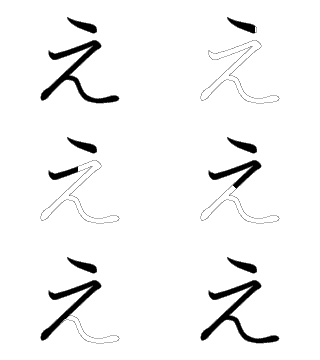
Hiragana Card – え

Hiragana E

え

3048 - e

Reading: e

Strokes: 2

Variations: none


HIRAGANA & KATAKANA TEST

Just follow this Twitter account and start receiving 10 tweets per day with randomly selected hiragana and katakana including links to the solution.


PRACTICE WRITING THE HIRAGANA え – E

Download the NIHONGO ICHIBAN PRINT YOURSELF Hiragana & Katakana Workbook and practice writing hiragana on worksheets that you can print at home as often as you like.

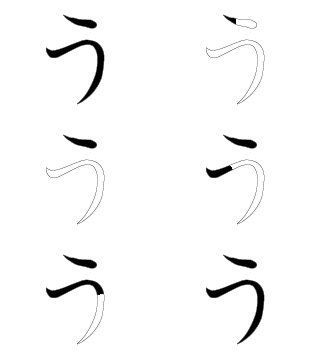
Hiragana Card – う

Hiragana U

う

3046 - u

Reading: u

Strokes: 2

Variations: none


HIRAGANA & KATAKANA TEST

Just follow this Twitter account and start receiving 10 tweets per day with randomly selected hiragana and katakana including links to the solution.


PRACTICE WRITING THE HIRAGANA う – U

Download the NIHONGO ICHIBAN PRINT YOURSELF Hiragana & Katakana Workbook and practice writing hiragana on worksheets that you can print at home as often as you like.
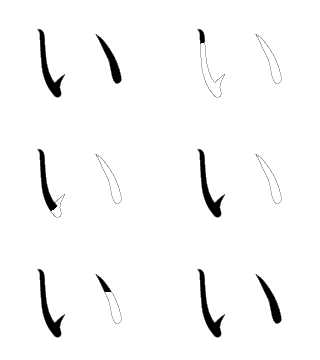
Hiragana Card – い

Hiragana I

い

3044 - i

Reading: i

Strokes: 2

Variations: none

The origin of this Hiragana


HIRAGANA & KATAKANA TEST

Just follow this Twitter account and start receiving 10 tweets per day with randomly selected hiragana and katakana including links to the solution.


PRACTICE WRITING THE HIRAGANA い – I

Download the NIHONGO ICHIBAN PRINT YOURSELF Hiragana & Katakana Workbook and practice writing hiragana on worksheets that you can print at home as often as you like.
Particle も (mo)

This particle is used to express “too” or “as well”. It always is related to the precedent noun. In case that the noun is followed by the particles が (ga) or は (ha) these are replaced by も (mo). In case that the precedent noun is followed by the particles に (ni) or で (de) the particle も (mo) is attached to the precedent particle.

Example 1:

私も日本人です。

わたしもにほんじんです。

watashi mo nihonjin desu.

I am Japanese too.

Example 2:

日本でもお天気がいいです。

にほんでもおてんきがいいです。

nihon demo otenki ga ii desu.

The weather in Japan is good too.

Example 3:

私は東京にも行きます。

わたしはとうきょうにもいきます。

watashi wa toukyou nimo ikimasu.

I will also go to Tokyo.


Particle の (no)

This particle is used to construct genetive and expresses possession or a relation between two nouns. This also works for multiple relations as shown in the example sentence. The main noun always comes last.

Example:

私の友達の本です。

わたしのともだちのほんです。

watashi no tomodachi no hon desu.

This is my friend’s book.